Featured post

When out fossil hunting...

So I thought I would do a post about things to remember when out and about doing your own fossil hunts, hopefully you'll find it helpfu...

Showing posts with label triassic. Show all posts

Wednesday, 6 June 2018

Lapworth Museum (and a trip to Aust Cliff)

Last year, while visiting friends in Birmingham, we went along to the Lapworth Museum. Despite Birmingham not having the richest fossil record in the world, the fossils on display were diverse and very interesting. They were not limited to UK fossils, as you will become abundantly aware when you enter and are met with an Allosaurus skeleton. Because it had worldwide fossils on show it did make for a worthwhile visit.

The Allosaurus skeleton that greets you when you enter the Lapworth Museum.
There is a display devoted to more local fossils, this is the Palaeozoic of the Welsh Borders. These featured a diverse array of trilobites, crinoids and graptolites.

But best of all (at least for me!) is the display of plaster models of foraminifera. There is also a microscope next to this showing the true size of foraminifera and other microfossils.


Plaster models showing the range of shapes of benthic and planktic foraminifera.
Although a small museum it is easy to spend a while here to appreciate everything it has to offer.

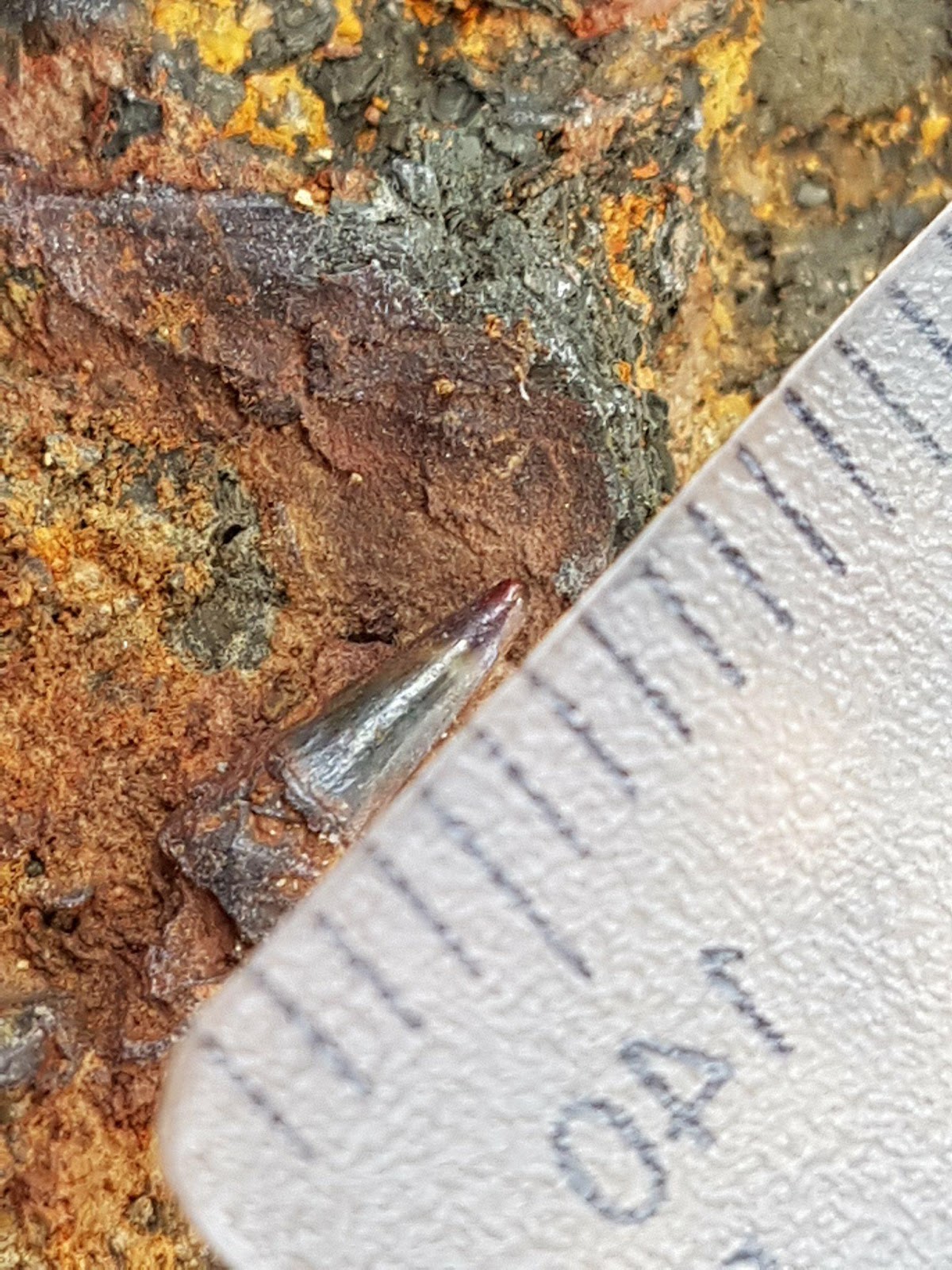
I also went on a quick trip to Aust Cliff under the Severn Bridge. This is a site that, at its base, is dominated by the Mercia Mudstone Formation. Unfortunately this is largely unfossiliferous. However, the overlying Rhaetian Bone Bed and Blue Lias can be very fossiliferous. Blocks of Triassic rock fall from the top of the cliff sometimes packed with bones of reptiles. We didn't manage to find these bone blocks but did manage to see three different reptile teeth. They were cemented into large pieces of rock so couldn't be collected.

Tooth from Aust Cliff.


Saturday, 26 May 2018

Lyme Regis (and a passing visit to Charmouth)

In this second part to the Dorset Fieldwork I will show you all the world famous Lyme Regis Lias outcrops. These were incredibly interesting both geologically and palaeontologically. Our trip leader, Professor David Martill found something very exciting when making our way back to the coach.

We visited the beach to the west of the town of Lyme Regis, Monmouth Beach.

Lyme Regis (with a quick stop at Charmouth):


Map of West Dorset showing the location of Monmouth Beach.
(Source: Google Maps)
The alternating succession of shales and argillaceous
limestones at Monmouth Beach. (Source:
https://www.shutterstock.com/video/clip-5416676-stock-
footage-the-blue-lias-beds-and-limestone-pavement-on-
monmouth-beach-cliffs-lyme-regis-on-the-jurassic.html
)
The limestone ammonite pavement, or ammonite
graveyard. (Source: https://chandlerscottage.co.uk/1
125x750-lyme-regis-0772/
)
In the morning after a rather lengthy drive from Swanage, we arrived in Charmouth. Although we didn't actually go onto the beach to see the cliffs up close, we got a pretty good view of the geology. I have also visited this site a number of times and will post the fossils I found in my collection series.

When standing at the Charmouth Heritage Centre, if you were to look to the west towards Lyme Regis those dark clay cliffs are called Black Ven. To the east you have Stonebarrow and the Golden Cap.

Charmouth is a Jurassic succession being deposited during the Sinnemurian to Pliensbachian ages of the lower Jurassic, approximately 190 Ma.

Black Ven is highly fossiliferous with ammonites being the most common fossil you will find. If you are very lucky you can also find crinoids, Ichthyosaur and Plesiosaur remains. A complete dinosaur, Scelidosaurus, has also been found here and is on display in the Charmouth Heritage Centre. Another must see is in the fossil shop, where they have on display a large Temnodontosaurus skull.

This is also one of the sites that Mary Anning collected from, finding marine reptiles and the pterosaur, Dimorphodon macronyx, later described by Sir Richard Owen.

After this brief talk we then drove a bit further west into Lyme Regis and walked down onto Monmouth Beach. Here you will notice, similar to Kimmeridge Bay, a repeating pattern in the cliffs between shales and argillaceous limestones, another example of Milankovitch Cyclicity.

But the really interesting thing to see here is in the wave cut platform that is formed by one of these bands of limestone. It is covered in hundreds of ammonites, the majority are of the genus Coroniceras. This was a single event where all of these ammonites died at the same time, this was gradual, possibly they returned to the same site seasonally. Ammonites won't be the only fossil you find here, you can also spot nautiloids, crinoids and gastropods. A complete Plesiosaur was even found in the pavement some years back.

If you wet the limestone around an ammonite you will find dark marks in the rock. These are fossilised burrows. Some are branching 'Y' shapes, this is formed by a shrimp, the name given to these burrows is Thalassinoides. Others will be two circles next to each other (Diplocraterion), straight burrows (Planolites), and some very fine burrows. These very small burrows are called Chondrites and show that the water had become anoxic for a period.

On the walk to the next locality, Professor Andy Gale found a large nautilus, preserved in three dimensions, a very nice find indeed. It was picked up by a course mate on the way back to the coach.

The next site was geologically of interest. This was the boundary between the limestone dominated White Lias, to the shale of the Blue Lias. The interesting part is, lithologically speaking the boundary is very clear, you can see a pale limestone become a dark shale. You would be forgiven for thinking that this is simply the boundary between the Rhaetian of the Triassic and the Hettangian of the Jurassic.

But to date the rock to confirm this is very difficult. The use of lavas of similar ages are regularly used to radiometrically date rock, however, there are no lavas to use. So dating could be done with the fossils, using relative dating. The change in the ammonites present between the White and Blue Lias represents a biological boundary. This is higher in the succession than the lithological boundary.

On the way back, Professor Dave Martill came across some Ichthyosaur remains in a limestone band of the Blue Lias. Unfortunately I did not see it but there was enough articulated material to warrant him going back to recover it.

Tuesday, 16 August 2016

The Big Five Mass Extinctions

Mounted Brachiosaurus skeleton at the
Naturkunde Museum in Berlin, Germany. The dinosaurs

were the major casualties of the K/T Extinction. Image
credit: Bill Sellers
As I said in my Devonian post yesterday, I am going to cover the Five biggest mass extinctions in the Earth's history. We will look at these from the one with the least impact on global species to the one with the most impact. You will notice that when reading the statistics for what went extinct that the number of species will be higher than the number of families or genera that were lost, this is because you can have vast numbers of species die out without losing a genera if some species are to survive. For instance, the Sarcopterygii that was discussed in the Devonian post largely have died out but the whole class was not lost as it survives with the lungfish and Coelacanth. I am also using marine life families as some of the extinctions took place when there was little or no life on land.

#5: The Cretaceous Tertiary Extinction 
Also known as the K/T Extinction or K/Pg Extinction, Pg being the Palaeogene period that followed the Cretaceous, is famed for being the extinction that wiped out the dinosaurs and closed the Age of Reptiles. Extensive studies, including the drilling of boreholes, of the Chicxulub crater off the coast of the Yucatan Peninsula in Mexico have given a clearer picture of what happened 66 Ma. An asteroid nearly six miles wide smashed into the earth, this caused a chain reaction of events that doomed the dinosaurs. After the impact, mass volcanism, particularly around the Deccan Traps area in India, polluted the atmosphere and caused the Earth to heat up. Sea levels also fell by 150 metres which could be attributed to the loss of the marine life as many would have depended on shallower seas to survive. 
Marine Families Lost: 16%
Genera Lost: 67%
Species Lost: Approximately 76% including non avian dinosaurs, marine reptiles, pterosaurs and ammonites.
Artist's impression of the Chicxulub Crater. Image credit:
Detlev van Ravenswaay

#4: End Triassic Extinction
Little is known about the causes of this extinction that took place 201 Ma, but we do see evidence of falling sea levels which is potentially the reason behind a larger loss of ocean species, including some marine reptiles. There is also sedimentary evidence for volcanic rifting that took place as Pangaea broke apart. Taking place over where North America, Europe and Africa would have been on the supercontinent, the air would have been toxic to nearby ecosystems, another possible reason for an extinction event. 
Marine Families Lost: 22%
Genera Lost: 53%
Species Lost: Approximately 80% including most mammal-like reptiles and large amphibians, surprisingly plants made it through largely unscathed. 

#3: Devonian Period's Two Extinction Events
There were two separate events of extinction in the Devonian; the first being the Kellwasser, in the late middle Devonian, which pushed corals and jawless fish to extinction as well as reducing trilobite species. The second was the Hangeberg, which took place on the Devonian-Carboniferous boundary, was responsible for the extinction of Placoderms and many early ammonite species. The Hangeberg extinction event is believed to have been the result of global cooling due to increased volcanic activity. There is also evidence of eutrophication in the shallow seas. This is where there is an excess of nutrients, usually caused by the run off water from the land, this causes algal blooms. These blooms are disastrous for marine life as it prevents sunlight from penetrating the water, thus there is no replenishment of the oxygen that the algae removes from the water, which in turn kills the marine life that depend on the oxygen rich waters. The result of this is the coral reefs not making a return for another 100 million years.
Marine Families Lost: 22%
Genera Lost: 57%
Species Lost: Approximately 83% 

#2: End Ordovician Extinction
Taking place between 445 and 440 Ma, it is believed that an intense global ice age was the trigger for the event. As the supercontinent of Gondwana moved further South to take it's place over the South Pole, vast glaciers spawned gradually lowering global temperatures and therefore causing a fall in sea levels. It is believed that the sea levels fell by between 70 and 100 metres. 
Marine Families Lost: 26%
Genera Lost: 60%
Species Lost: 85%

#1: End Permian Extinction
The largest extinction event in Earth's history took place at the end of the Permian period and the end of the Palaeozoic Era around 252 Ma. Also known as the "Great Dying", the causes are unknown for certain, however, we already know that Pangaea was incredibly hot and dry which would push a great many of species to the brink. But we also see a spike in greenhouse gases such as Carbon Dioxide and Methane that would have been released from frozen stores in the oceans. Combined with one of the biggest volcanic eruptions ever and we can start to see why so many species were lost at the close of the Permian. 97% of all species that were present on Earth in the Permian were wiped out 252 Ma, all life that followed, the majesty of the dinosaurs, the radiation of mammals and eventually the success of Homo sapiens can all be traced back to the 3% of species that clung to survival at the end of the Palaeozoic Era.
Marine Families Lost: 51%
Genera Lost: 82%
Species Lost: 97%

I hope you find this helpful and interesting, let me know what you think in the comments.