Featured post

When out fossil hunting...

So I thought I would do a post about things to remember when out and about doing your own fossil hunts, hopefully you'll find it helpfu...

Showing posts with label museum. Show all posts

Wednesday, 6 June 2018

Lapworth Museum (and a trip to Aust Cliff)

Last year, while visiting friends in Birmingham, we went along to the Lapworth Museum. Despite Birmingham not having the richest fossil record in the world, the fossils on display were diverse and very interesting. They were not limited to UK fossils, as you will become abundantly aware when you enter and are met with an Allosaurus skeleton. Because it had worldwide fossils on show it did make for a worthwhile visit.

The Allosaurus skeleton that greets you when you enter the Lapworth Museum.
There is a display devoted to more local fossils, this is the Palaeozoic of the Welsh Borders. These featured a diverse array of trilobites, crinoids and graptolites.

But best of all (at least for me!) is the display of plaster models of foraminifera. There is also a microscope next to this showing the true size of foraminifera and other microfossils.


Plaster models showing the range of shapes of benthic and planktic foraminifera.
Although a small museum it is easy to spend a while here to appreciate everything it has to offer.

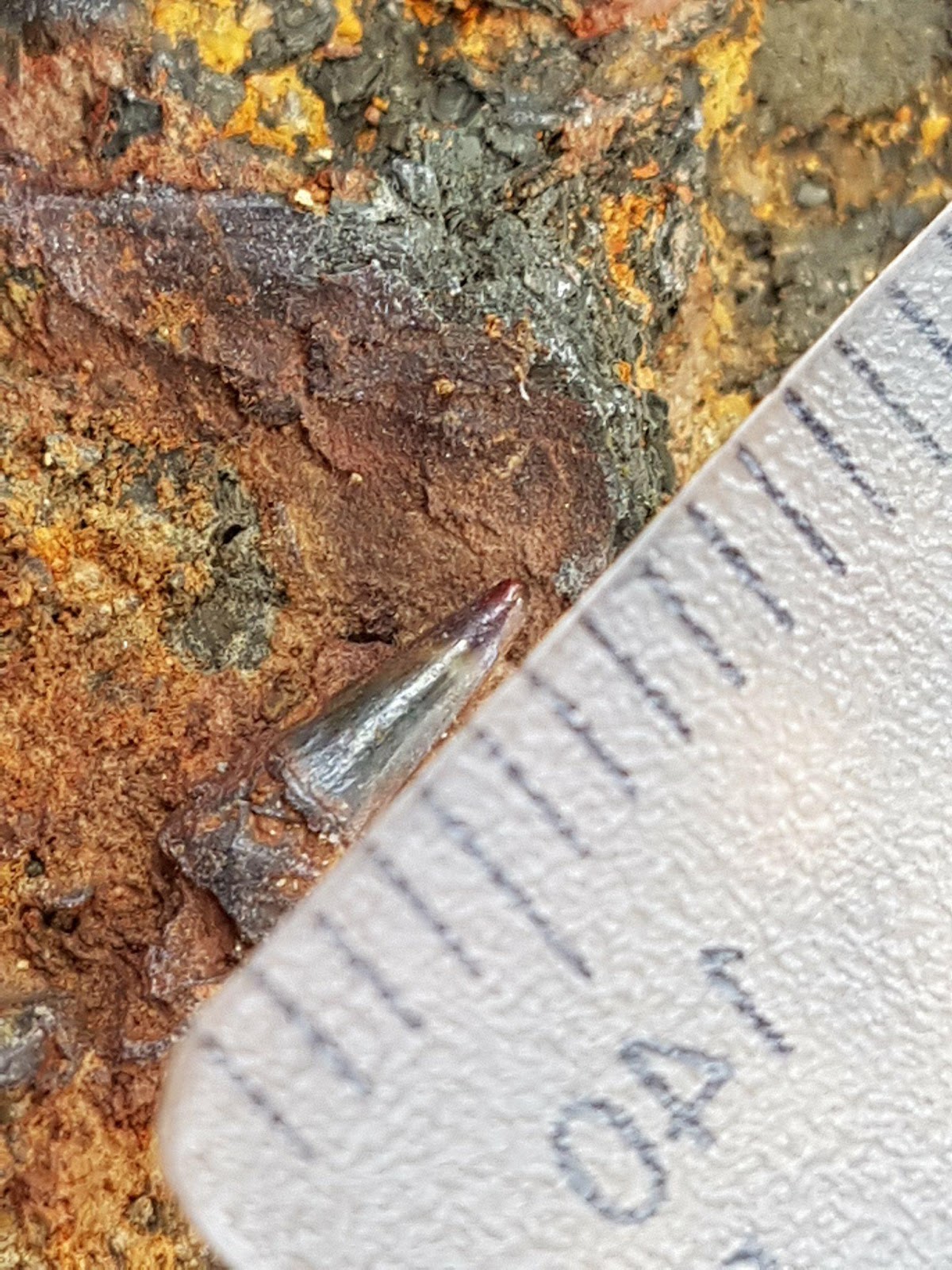
I also went on a quick trip to Aust Cliff under the Severn Bridge. This is a site that, at its base, is dominated by the Mercia Mudstone Formation. Unfortunately this is largely unfossiliferous. However, the overlying Rhaetian Bone Bed and Blue Lias can be very fossiliferous. Blocks of Triassic rock fall from the top of the cliff sometimes packed with bones of reptiles. We didn't manage to find these bone blocks but did manage to see three different reptile teeth. They were cemented into large pieces of rock so couldn't be collected.

Tooth from Aust Cliff.


Friday, 1 June 2018

Museums: Hessiches Landesmuseum, Darmstadt


This museum in Darmstadt, Germany, varies in its collections. We were only interested in their Palaeontological collection, although we did have a look at the zoological displays also. So, lets take a look at some photographs from the museum. Again, not much to say, but plenty to look at.


This is what greets you when you enter the geology and palaeontology gallery, an American Mastodon. 
Side view of the American Mastodon skeleton.


Part of the palaeontological collection also includes fossils from the Pleistocene of the area. This is the giant Irish Elk, Megaloceros.
This is the skull of the primitive proboscidean, Deinotherium. This elephant ancestor is easily identified by the short tusks that protrude from the lower jaw.

The complete skeleton of the early horse from the Messel Grube pit, Propalaeotherium. There is an example of this horse that is pregnant. The pale slab that the fossil is displayed on is the resin used in the transfer method mentioned in my Messel Grube post.
This is just one of many examples of the fossil fish that have been found in the Messel pit. My class was very fortunate to discover two of these gar pikes.

One of the rarer bird fossils found at Messel. This is an Eocene Ibis.
The more common bird is Messelornis.
Messel was also home to a diverse population of crocodiles, varying in size and orientations. This particular specimen was preserved in three dimensions, coming to rest on the bottom of the lake on its side.
This is the exceptionally well preserved skull of a larger genus of crocodile from the Messel pit.

The diverse reptile fauna also included snakes of various sizes. This was one of the largest on display.

Thursday, 31 May 2018

Museums: Hauff Museum, Holzmaden

In this series I would like to share photographs of fossils and exhibitions from museums that I have visited. There won't be a lot to say about them so this will be mainly photographs of what I thought was pretty outstanding.

This post features some photographs taken in the Hauff Museum at Holzmaden. It is devoted to the palaeontology of the Posidonia Schieffer and exhibits a range of fantastic fossils, including invertebrates, marine reptiles, fish and pterosaurs. Enjoy.

The Hauff Museum featured a stepped profile of the stratigraphy through the Posidonia Schieffer. Each bedding surface featured a different fossil groups. You can see a marine crocodile (Steneosaurus) in the middle. It also featured plesiosaurs and ichthyosaurs.
An example of the most common fossils found in the Posidonia Schieffer; ammonites. These ammonites vary in size from a centimetre in diameter to around 40 centimetres (that we saw). 
This particular bedding surface exhibits the most spectacular of the fossils found in the shale. The long dark fossil is a piece of driftwood. Attached to it are crinoids (sea lillies). The wood along with the crinoids would have floated in the water column until the weight of the crinoids and bivalves became too much and the wood sank and became buried in the soupy sea floor.

This is a rather complete fossil of a hybodont shark. These sharks are easily recognisable from their fin spines that precedes their dorsal fins. The cause of death for this particular shark is believed to be that of greed. The palaeontologists here believe that this shark ate too many belemnites including the guards, which caused it to increase its weight, eventually the shark became to float and subsequently died. The belemnite guards are still in the stomach of the shark.
This is the fossil of one of the largest Ichthyosaurs. This is Temnodontosaurus, fossils of this are found throughout Europe, a skull is on display at the Charmouth Fossil Shop that was found in the Blue Lias. This animal would have been the top predator of the Jurassic seas. Sir David Attenborough's recent documentary on an Ichthyosaur from Lyme Regis is evidence that Temnodontosaurus hunted smaller Ichthyosaurs.
This is by far the most impressive specimen in the museum. This is an 18m long piece of driftwood that has been colonised by crinoids and bivalves. This makes visiting the museum well worth it.